

One of the first things I did when the New Year rang in was to take a conscious decision to stay away from social media — completely, at least for a while. The idea wasn’t to quit forever, but to step back, breathe, and see if I could someday return with boundaries firmly in place. I don’t know how long this detox will last, but it was something I felt I had to do.
Initially, I thought I’d write about everything that’s wrong with present-day social media. But that would have turned into yet another rant — the kind that gets written, shared briefly, and then quietly forgotten. As I typed, something else happened. I found myself drifting into nostalgia, thinking about what social media once meant.
And then it struck me — I’m old enough now to talk about those days.
So why not?
So let’s turn the clock back from 2026 to 2004.
Back to a time when social media actually meant being social.
Those were the days of Orkut, MySpace, Friendster, Hi5, Multiply — to name a few of the popular platforms back then.
Orkut: Where It All Began (At Least for Us)
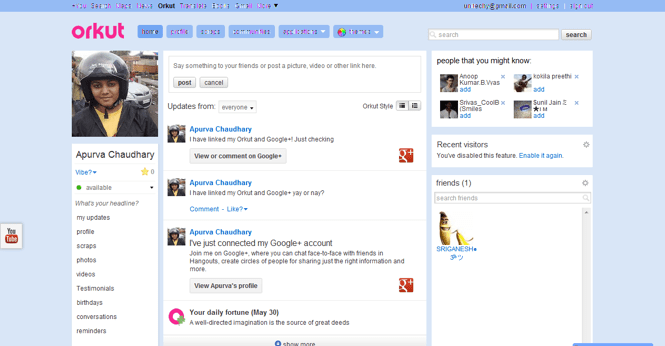
The most popular of them all was, of course, Orkut. I remember signing up sometime around 2004 or 2005. Compared to today’s platforms, it was incredibly basic — but it was also endlessly fun.
Once you set up your profile, you had a personal scrapbook where friends posted “scraps.” You replied, others chimed in, and entire conversations unfolded publicly. Long before tweets, stories, and snaps, we had scraps. And honestly, if we hadn’t normalised scraps back then, Gen Z today might never have had tweets or snaps at all.
Orkut had friends, fans, and trusted users. Testimonials were prized possessions — we practically begged our friends to write one so we could proudly display it on our profiles. Photo sharing was minimal, partly because we feared misuse (ironically, we boldly share pictures now in an age dominated by AI and facial recognition), and partly because internet speeds were so slow that uploading photos felt like an act of patience and faith.
But my favourite feature — by far — was Orkut Communities.
These weren’t communities divided by politics or ideology. They were simple, topic-based discussion groups where people shared experiences, humour, frustration, and vulnerability. I vividly remember being part of a community where we wrote a story one sentence at a time. Imagine 300 people, each adding a sentence after the previous one. The stories took such bizarre turns that “weird” would be an understatement — and that was precisely the charm.
Some classic community names still make me smile:
• I Study One Night Before Exams
• I Sleep in Class
• I Have No Life
• Engineering / MBBS Ruined My Life
• I Talk to Myself
• I Open the Fridge and Forget Why
• I Downloaded the Movie but Got Something Else
• Unspoken Love
• One-Sided Love
• I Still Love My Ex
• People Who Fell for Their Best Friend
It sounds ridiculous now, doesn’t it? But those communities brought us together in ways today’s social media rarely does. There were no like counters, no follower numbers, and your face didn’t matter. All that mattered were your words.
You could be anonymous.
Awkward.
Honest.
And you didn’t fear backlash or trolling.
Someone once said it perfectly:
“Orkut communities weren’t about being seen. They were about being understood.”
⸻
MySpace: Truly Your Space

Then there was MySpace — more Western in flavour. While Orkut thrived in India and Brazil, MySpace was the king of American social media.
Unlike Orkut, MySpace profiles were fully customisable. You could change colours, backgrounds, fonts, add glitter effects, scrolling text, rearrange boxes — sometimes to the point where readability was completely sacrificed. And we thought Instagram’s static layouts were cool.
MySpace really was your space.
It also had the infamous Top 8 friends feature — a public ranking of your closest friends. Just imagine the audacity. The heartbreak of not making someone’s Top 8. Girlfriends and boyfriends expected to be Top 1; slip to Top 2 and a fight was guaranteed. Disappear entirely and it was the early-2000s equivalent of being unfollowed after a breakup.
MySpace also allowed long-form blogs, and people actually took the time to read them — even posts written by strangers. It was also the Spotify of the internet before Spotify existed. Open a profile and music would blare automatically — Linkin Park, Eminem, Green Day — no warnings, no volume control.
There were bulletins for announcements (the ancestors of tweets), poetry, emotional rants, and heartfelt confessions. It was messy, loud, emotional — and deeply human.
Hi5, Multiply & Friendster


Platforms like Hi5, Multiply, and Friendster were quite similar — almost watered-down versions of Orkut. I had profiles on all of them, though I used Hi5 a bit more than the others. Still, none of them quite captured me the way Orkut and MySpace did.
⸻
So Why Did It Feel Different Back Then?
Why didn’t we feel the need for a social media detox back then?
Part of it, of course, was painfully slow internet speeds. There were no apps — accessing these sites on early smartphones was torture enough to act as a natural detox.
But more importantly, it was an era of algorithm-free networking.
We had conversations — real ones — with known and unknown people. Social media felt like a hostel common room. We secretly kept an eye on the scrapbook of the boy or girl we were interested in to see who else was exchanging scraps with them. We weren’t afraid of being trolled for our opinions because there were no trolls back then. Scraps mattered more than stories. People didn’t curate fake versions of their lives for validation. No one was compelled to scroll endlessly through reels while watching a movie, a cricket match, or even during face-to-face conversations.
Follower counts didn’t define self-worth.
Likes weren’t wired into our dopamine circuits.
It was simpler. Slower. Kinder.
And maybe that’s why stepping away from social media today feels less like quitting — and more like trying to go home.
Maybe we don’t miss old social media because of the platforms themselves.
Maybe we miss the version of ourselves that logged in with curiosity instead of compulsion, with words instead of filters, and with time instead of urgency.
Back then, we went online to connect, to have a good time, to escape the monotony of the real world.
Today, we go online because the algorithms draw us in, and once we reach the point of brain rot, we search for means to escape that fake world.
Social media was a place you visited, not a place you lived in.
And maybe this detox isn’t about disconnecting from the internet at all —
maybe it’s about reconnecting with what being social once meant.

